
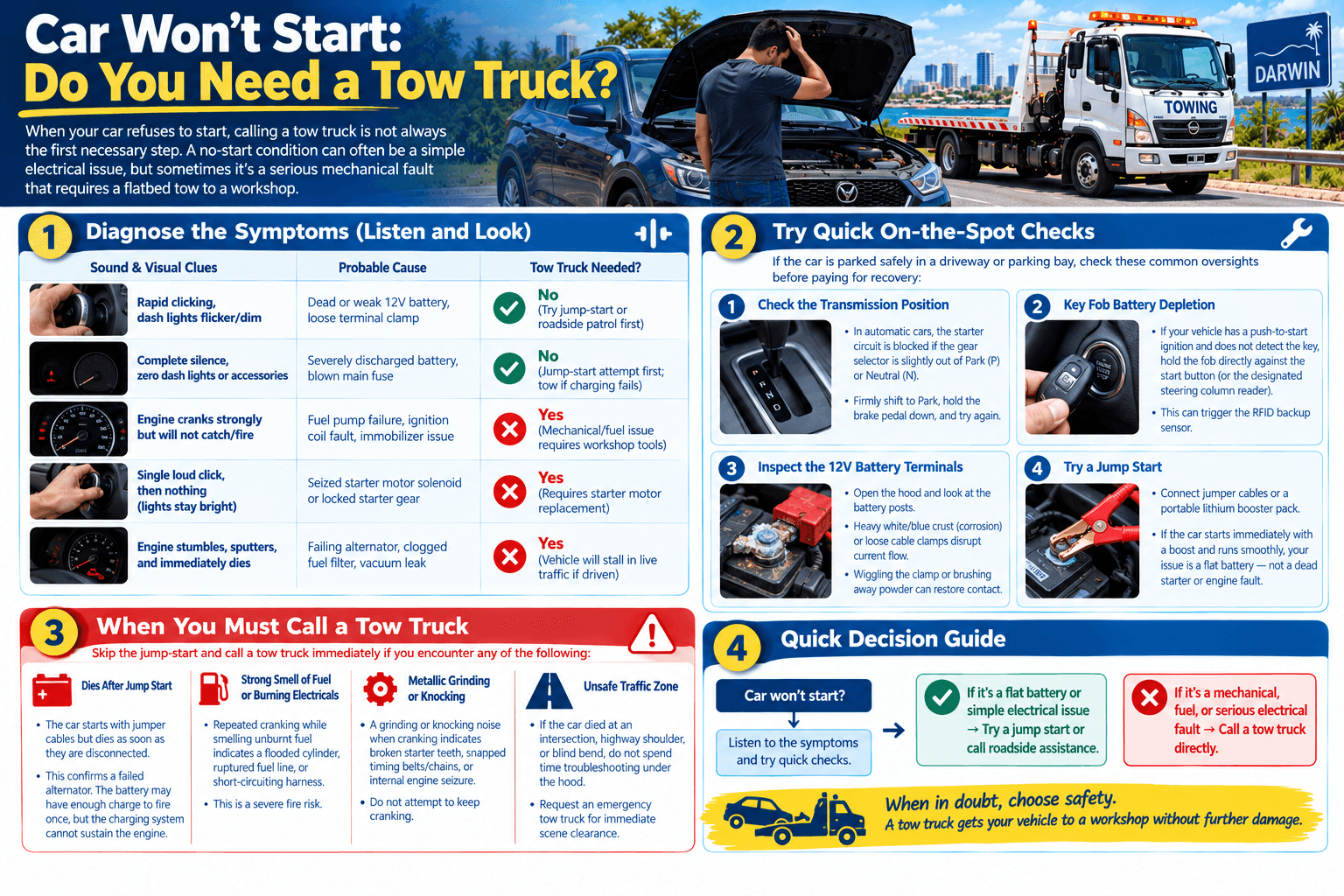
When your car refuses to start, calling a tow truck is not always the first necessary step. A no-start condition generally falls into two distinct categories: electrical supply failures that can be fixed on the spot with roadside assistance, and mechanical, fuel, or internal electrical failures that require a flatbed tow to a workshop.
Step 1: Diagnose the Symptoms (Listen and Look)
Before reaching for the phone, turn the ignition key (or press the push-to-start button) and note what happens:
| Sound & Visual Clues | Probable Cause | Tow Truck Needed? |
|---|---|---|
| Rapid clicking, dash lights flicker/dim | Dead or weak 12V battery, loose terminal clamp | No (Try jump-start or roadside patrol first) |
| Complete silence, zero dash lights or accessories | Severely discharged battery, blown main fuse | No (Jump-start attempt first; tow if charging fails) |
| Engine cranks strongly but will not catch/fire | Fuel pump failure, ignition coil fault, immobilizer issue | Yes (Mechanical/fuel issue requires workshop tools) |
| Single loud click, then nothing (lights stay bright) | Seized starter motor solenoid or locked starter gear | Yes (Requires starter motor replacement) |
| Engine stumbles, sputters, and immediately dies | Failing alternator, clogged fuel filter, vacuum leak | Yes (Vehicle will stall in live traffic if driven) |
Step 2: Try Quick On-the-Spot Checks
If the car is parked safely in a driveway or parking bay, check these common, simple oversights before paying for recovery:
- Check the Transmission Position: In automatic cars, the starter circuit is blocked if the gear selector is slightly out of Park (P) or Neutral (N). Firmly shift to Park, hold the brake pedal down, and try again.
- Key Fob Battery Depletion: If your vehicle has a push-to-start ignition and does not detect the key, hold the fob directly against the start button (or the designated steering column reader) to trigger the RFID backup sensor.
- Inspect the 12V Battery Terminals: Open the hood and look at the battery posts. Heavy white/blue crust (corrosion) or loose cable clamps disrupt current flow. Wiggling the clamp or brushing away powder can restore contact.
- Try a Jump Start: Connect jumper cables or a portable lithium booster pack. If the car starts immediately with a boost and runs smoothly, your issue is a flat battery—not a dead starter or engine fault.
Step 3: When You Must Call a Tow Truck
Skip the jump-start and call a tow truck immediately if you encounter any of the following:
- The Car Dies as Soon as Jumper Cables Are Disconnected: This confirms a failed alternator. The battery may have enough surface charge to fire once, but the charging system cannot sustain the engine’s spark plugs and electronic control units. The car will stop within seconds of moving.
- Strong Smell of Raw Fuel or Burning Electricals: Repeated cranking while smelling unburnt fuel indicates a flooded cylinder, ruptured high-pressure fuel line, or short-circuiting harness—a severe fire risk.
- Metallic Grinding or Knocking When Cranking: Indicates broken starter teeth, snapped timing belts/chains, or internal engine seizure.
- Stranded in an Unsafe Traffic Zone: If the car died at an intersection, highway shoulder, or blind bend, do not spend time troubleshooting under the hood. Request an emergency tow truck for immediate scene clearance.
Need an Honest, Upfront Towing Quote in Darwin?
Our tilt trays are on call 24/7 across Darwin, Palmerston, and surrounding NT highways.