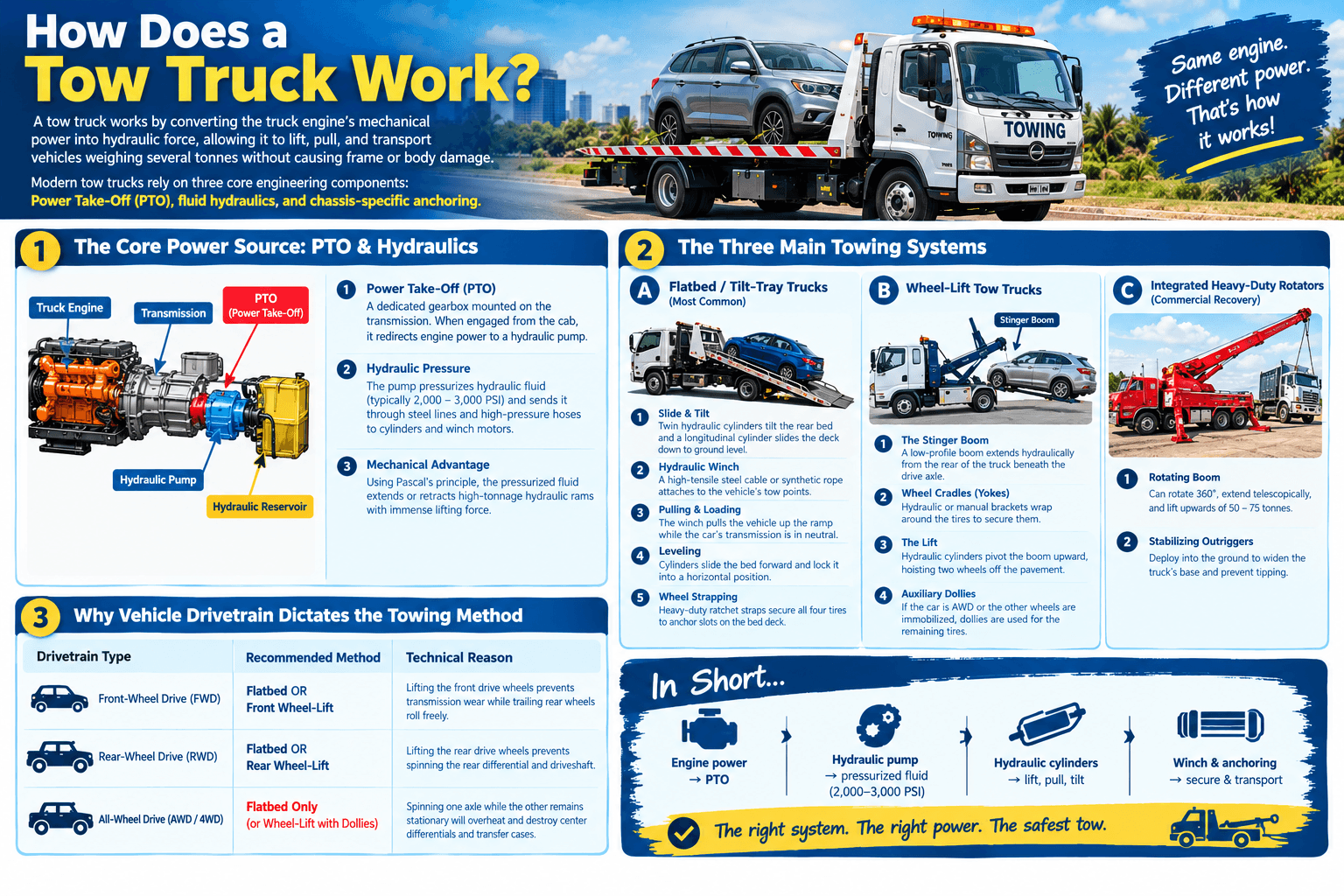
A tow truck works by converting the truck engine’s mechanical power into hydraulic force, allowing it to lift, pull, and transport vehicles weighing several tonnes without causing frame or body damage. Modern tow trucks rely on three core engineering components: Power Take-Off (PTO), fluid hydraulics, and chassis-specific anchoring.
Why Vehicle Drivetrain Dictates the Towing Method
| Drivetrain Type | Recommended Method | Technical Reason |
|---|---|---|
| Front-Wheel Drive (FWD) | Flatbed OR Front Wheel-Lift | Lifting the front drive wheels prevents transmission wear while trailing rear wheels roll freely. |
| Rear-Wheel Drive (RWD) | Flatbed OR Rear Wheel-Lift | Lifting the rear drive wheels prevents spinning the rear differential and driveshaft. |
| All-Wheel Drive (AWD / 4WD) | Flatbed Only (or Wheel-Lift with Dollies) | Spinning one axle while the other remains stationary will overheat and destroy center differentials and transfer cases. |
The Core Power Source: PTO & Hydraulics
Tow trucks do not rely on standard electric battery motors to lift heavy vehicles; they generate heavy force directly from the truck’s engine:
- Power Take-Off (PTO): A dedicated gearbox mounted directly onto the truck’s transmission. When engaged from the cab, it redirects rotational energy from the diesel engine to a hydraulic pump.
- Hydraulic Pressure: The pump pressurizes hydraulic fluid (typically between 2,000 and 3,000 PSI) and directs it through steel lines and high-pressure hoses into hydraulic cylinders and winch motors.
- Mechanical Advantage: Using Pascal’s principle, the pressurized fluid extends or retracts high-tonnage hydraulic rams with immense lifting force, allowing the driver to tilt entire steel decks, extend booms, or reel in stranded vehicles smoothly.
How the Three Main Towing Systems Operate
A. Flatbed / Tilt-Tray Trucks (Most Common)
Flatbeds are the preferred choice for passenger cars, luxury models, and all-wheel-drive (AWD/4WD) vehicles because all four wheels stay off the road during transit.
- Slide & Tilt: Twin hydraulic cylinders tilt the rear bed backward while a longitudinal cylinder slides the entire steel platform down to ground level, forming a low-angle ramp.
- Hydraulic Winch: A high-tensile steel cable or synthetic recovery rope unspools from the front of the bed and attaches to the vehicle’s rated tow points or chassis recovery eye.
- Pulling & Loading: The winch pulls the vehicle up the ramp while the car’s transmission rests in neutral.
- Leveling: The cylinders slide the bed forward and lower it back into its horizontal, locked travel position on the subframe.
- Wheel Strapping: Heavy-duty ratchet straps secure all four tires directly to anchor slots on the bed deck, letting the towed car’s own suspension absorb road bumps without shifting.
B. Wheel-Lift Tow Trucks
Wheel-lift systems replaced old hook-and-chain wreckers (which frequently scratched bumpers or bent suspension arms) by lifting a car solely by its tires.
- The Stinger Boom: A low-profile horizontal metal boom extends hydraulically from the rear of the truck beneath the car’s drive axle.
- Wheel Cradles (Yokes): Hydraulic or manual brackets wrap around the tires to secure them firmly in place.
- The Lift: Hydraulic cylinders pivot the boom upward, hoisting two wheels off the pavement while the vehicle rolls on its free-spinning tires.
- Auxiliary Dollies: If the car is AWD or the non-lifted wheels are immobilized, the operator slides small four-wheeled dollies under the trailing tires so no wheels contact the road.
C. Integrated Heavy-Duty Rotators (Commercial Recovery)
Used for overturned semi-trucks, buses, and industrial machinery, these specialized rigs combine an under-reach towing fork with a crane boom:
- Rotating Boom: The heavy-duty boom can rotate 360 degrees, extend telescopically, and lift upwards of 50 to 75 tonnes.
- Stabilizing Outriggers: Before any heavy side-pull or overhead lift begins, large hydraulic outriggers deploy into the ground to widen the truck’s base footprint and prevent it from tipping over.
Need an Honest, Upfront Towing Quote in Darwin?
Our tilt trays are on call 24/7 across Darwin, Palmerston, and surrounding NT highways.