When your vehicle breaks down, deciding whether to call a dedicated tow truck service or tap into roadside assistance comes down to one question: can the problem be solved on the shoulder, or does the vehicle need to be transported to a workshop?
While the two services often work together, they serve fundamentally different roles during a vehicle breakdown.
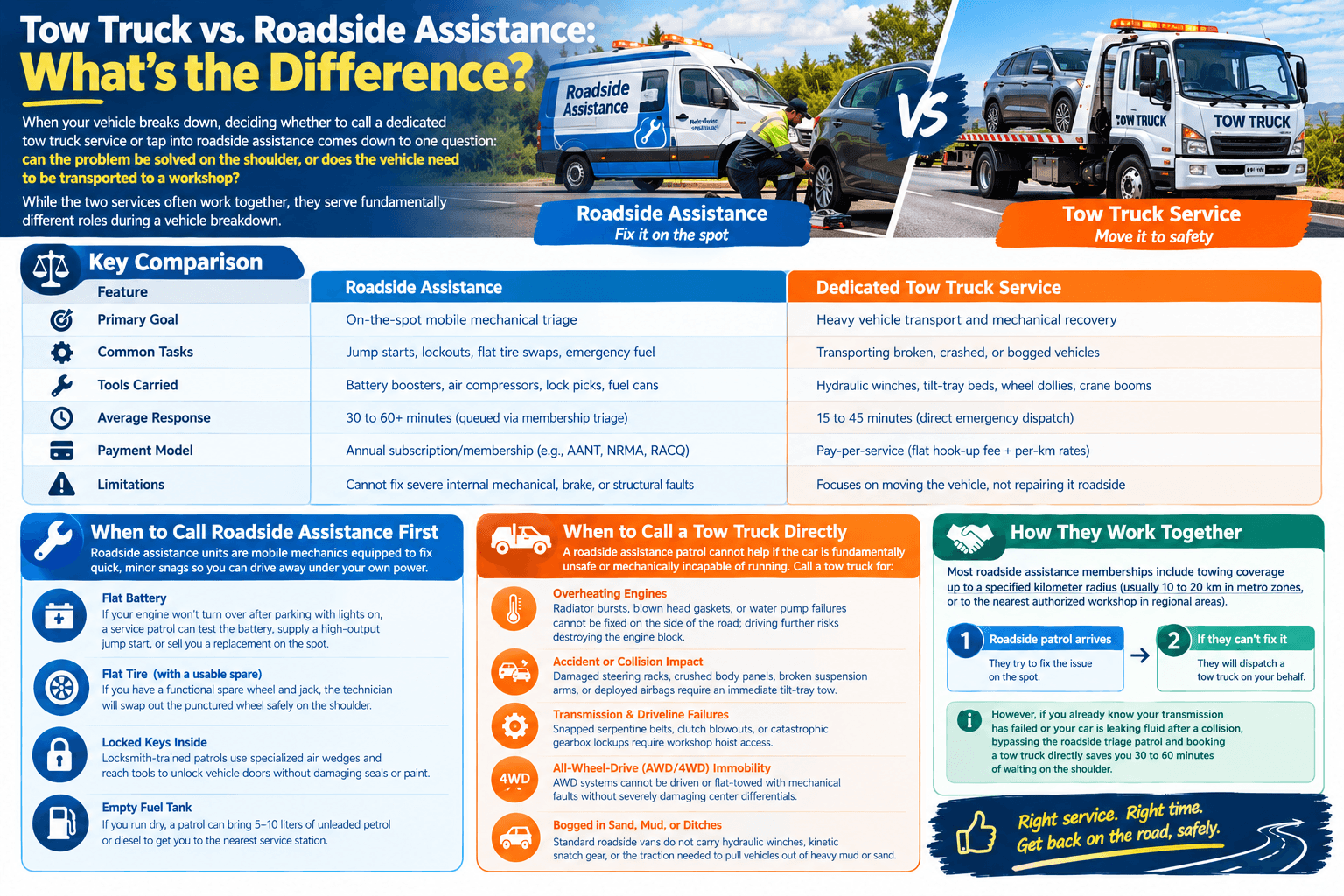
Key Comparison: Roadside Assistance vs. Tow Truck Service
| Feature | Roadside Assistance | Dedicated Tow Truck Service |
|---|---|---|
| Primary Goal | On-the-spot mobile mechanical triage | Heavy vehicle transport and mechanical recovery |
| Common Tasks | Jump starts, lockouts, flat tire swaps, emergency fuel | Transporting broken, crashed, or bogged vehicles |
| Tools Carried | Battery boosters, air compressors, lock picks, fuel cans | Hydraulic winches, tilt-tray beds, wheel dollies, crane booms |
| Average Response | 30 to 60+ minutes (queued via membership triage) | 15 to 45 minutes (direct emergency dispatch) |
| Payment Model | Annual subscription/membership (e.g., AANT, NRMA, RACQ) | Pay-per-service (flat hook-up fee + per-km rates) |
| Limitations | Cannot fix severe internal mechanical, brake, or structural faults | Focuses on moving the vehicle, not repairing it roadside |
When to Call Roadside Assistance First
Roadside assistance units are mobile mechanics equipped to fix quick, minor snags so you can drive away under your own power:
- Flat Battery: If your engine won't turn over after parking with lights on, a service patrol can test the battery, supply a high-output jump start, or sell you a replacement on the spot.
- Flat Tire (with a usable spare): If you have a functional spare wheel and jack, the technician will swap out the punctured wheel safely on the shoulder.
- Locked Keys Inside: Locksmith-trained roadside patrols use specialized air wedges and reach tools to unlock vehicle doors without damaging seals or paint.
- Empty Fuel Tank: If you run dry, a patrol can bring 5–10 liters of unleaded petrol or diesel to get you to the nearest service station.
When to Call a Tow Truck Directly
A roadside assistance patrol cannot help if the car is fundamentally unsafe or mechanically incapable of running. Call a tow truck directly for:
- Overheating Engines: Radiator bursts, blown head gaskets, or water pump failures cannot be fixed on the side of the road; driving further risks destroying the engine block.
- Accident or Collision Impact: Damaged steering racks, crushed body panels rubbing on tires, broken suspension arms, or deployed airbags require an immediate tilt-tray tow.
- Transmission & Driveline Failures: Snapped serpentine belts, clutch blowouts, or catastrophic gearbox lockups require workshop hoist access.
- All-Wheel-Drive (AWD/4WD) Immobility: AWD systems cannot be driven or flat-towed with mechanical faults without severely damaging center differentials.
- Bogged in Sand, Mud, or Ditches: Standard roadside vans do not carry hydraulic winches, kinetic snatch gear, or the traction needed to pull vehicles out of heavy mud or sand.
How They Work Together
Most roadside assistance memberships include towing coverage up to a specified kilometer radius (usually 10 to 20 km in metro zones, or to the nearest authorized workshop in regional areas).
If a roadside assistance patrol arrives and determines the car cannot be safely repaired on the spot, they will dispatch a tow truck on your behalf. However, if you already know your transmission has failed or your car is leaking fluid after a collision, bypassing the roadside triage patrol and booking a tow truck directly saves you 30 to 60 minutes of waiting on the shoulder.
Need an Honest, Upfront Towing Quote in Darwin?
Our tilt trays are on call 24/7 across Darwin, Palmerston, and surrounding NT highways.