Experiencing a sudden engine breakdown—whether your car loses power on a busy arterial road, stalls at an intersection, or starts knocking loudly on the highway—can be alarming. What you do in the first few minutes protects both your personal safety and your vehicle from permanent, costly internal damage.
Follow this step-by-step guide to secure your vehicle, avoid worsening mechanical faults, and coordinate a smooth recovery.
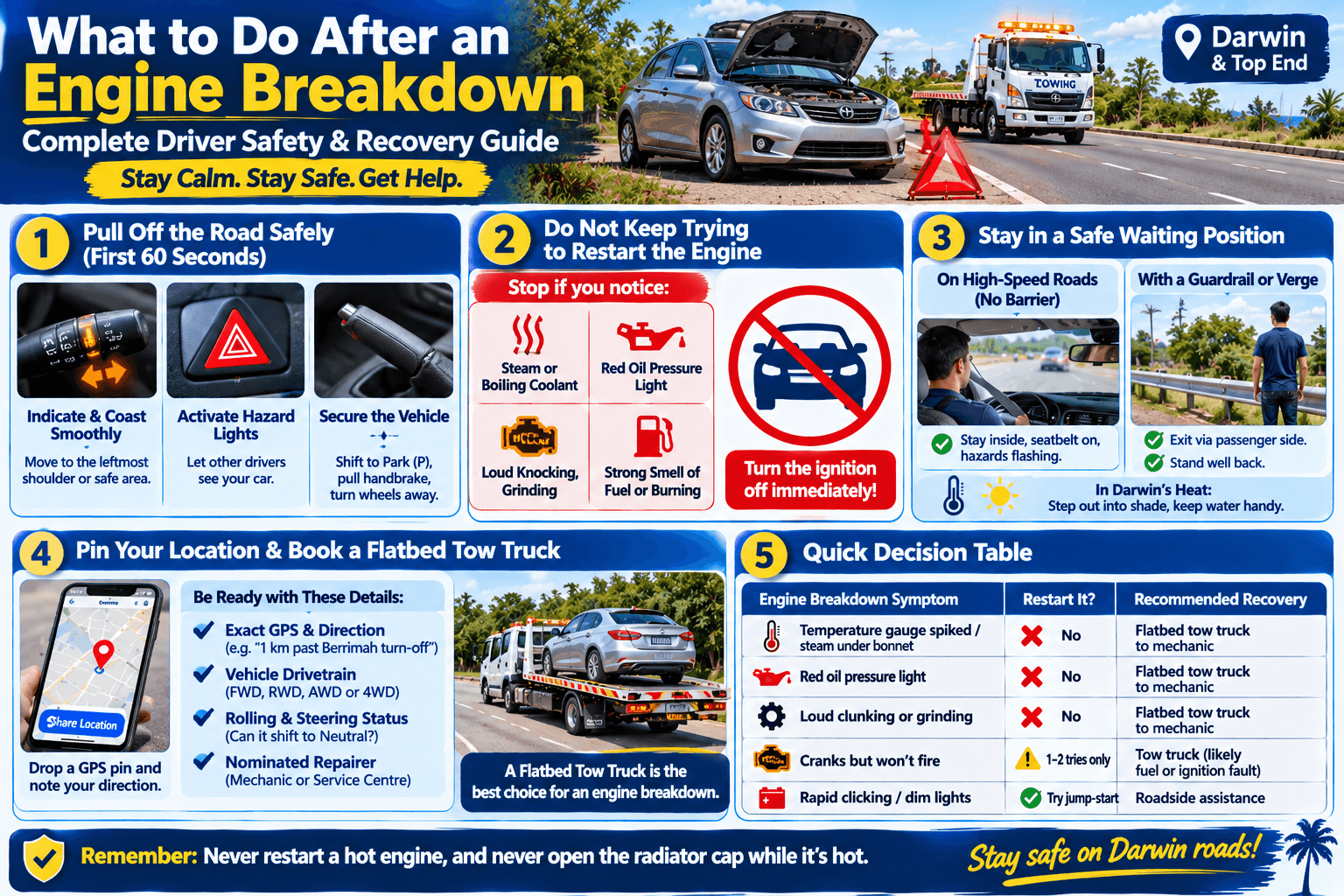
- Pull Off the Road Safely (First 60 Seconds)
When an engine cuts out, your vehicle loses power steering and power-assisted braking, making the wheel heavier and the brake pedal firmer. Use your remaining forward momentum wisely:
- Indicate and Coast Smoothly: Signal immediately and steer toward the leftmost emergency shoulder, breakdown bay, or side street. Avoid slamming on the brakes in active traffic lanes.
- Activate Hazard Lights Immediately: Switch on your hazard flashers right away. If it is dusk, raining, or dark, leave your parking/clearance lights on so approaching drivers can judge your vehicle's width and distance.
- Secure the Vehicle: Once stopped, shift into Park (P) (or 1st gear in a manual), pull the handbrake firmly, and turn your front wheels away from the road toward the verge or guardrail.
- Do Not Keep Trying to Restart the Engine
One of the most expensive mistakes drivers make after an engine breakdown is repeatedly cranking the ignition to "force" the car home. Do not restart the motor if you notice any of the following:
- Steam or Boiling Coolant: Indicates severe overheating. Running the engine even for another minute can warp aluminium cylinder heads or blow the head gasket.
- Red Oil Pressure Warning Light: Signals a loss of oil circulation. Continuing to run the engine with zero oil pressure will seize internal bearings and destroy the block.
- Loud Metallic Knocking, Grinding, or Clanking: Points to internal component failure, such as a snapped timing belt/chain or thrown connecting rod.
- Strong Smell of Raw Fuel or Burning Electricals: Indicates a ruptured fuel line or short-circuiting wiring harness, creating an immediate fire hazard.
- Stay in a Safe Waiting Position
Once the car is stationary and visible, decide where you and your passengers should wait based on your surroundings:
- On High-Speed Roads Without a Barrier: Stay inside the vehicle with your seatbelt fastened, doors locked, and hazards flashing. Stepping out near fast-moving highway traffic poses a severe risk.
- Where a Safety Guardrail or Wide Verge Exists: Exit strictly through the passenger-side door (away from oncoming traffic) and stand well behind the metal barrier or high up on the embankment.
- In Extreme Tropical Heat (e.g., Darwin & Top End Roads): Never sit inside a closed, unventilated vehicle with the A/C off, as cabin temperatures climb dangerously fast. Step out onto a safe, shaded verge away from traffic while keeping your vehicle in sight.
- Pin Your Location and Book a Flatbed Tow Truck
An engine breakdown almost always requires workshop diagnostics and hoist access, meaning a dedicated flatbed (tilt-tray) tow truck is usually the right call over standard roadside triage.
Before calling dispatch, gather these details:
- Exact GPS Pin & Direction: Open Google Maps, drop a pin on your location, and note your travel direction (e.g., "Outbound on the Stuart Highway, 1 km past the Berrimah turn-off").
- Vehicle Drivetrain: Specify whether your car is Front-Wheel Drive (FWD), Rear-Wheel Drive (RWD), All-Wheel Drive (AWD), or 4WD. AWD and automatic cars with dead engines must be carried on a flatbed so the transmission is not damaged while rolling.
- Rolling & Steering Status: Confirm whether the steering wheel unlocks and the gearbox shifts into Neutral (N) for winching.
- Nominated Repairer: Have the address of your preferred mechanic or service centre ready so the driver can deliver the vehicle directly.
Quick Decision Table: Post-Breakdown Actions
| Engine Breakdown Symptom | Should You Restart It? | Recommended Recovery |
|---|---|---|
| Temperature gauge spiked / steam under bonnet | No — Turn ignition off immediately | Flatbed tow truck to mechanic |
| Red oil pressure light illuminated | No — Risk of total engine seizure | Flatbed tow truck to mechanic |
| Loud clunking, snapping, or metallic grinding | No — Potential timing or internal failure | Flatbed tow truck to mechanic |
| Engine cranks strongly but refuses to fire | Limit to 1–2 brief tries (avoid draining battery) | Flatbed tow truck (likely fuel or ignition fault) |
| Rapid clicking noise / dim dashboard lights | No — Indicates a flat 12V battery | Roadside assistance jump-start first |
Need an Honest, Upfront Towing Quote in Darwin?
Our tilt trays are on call 24/7 across Darwin, Palmerston, and surrounding NT highways.