Breaking down in heavy traffic or along a high-speed arterial road is one of the most dangerous situations a driver can face. With vehicles travelling past at 80 to 110 km/h, oncoming motorists have only seconds to react to a stationary car.
Whether you lose engine power during peak-hour traffic or suffer a sudden mechanical fault on a busy highway, taking calm, decisive action in the first 60 seconds protects you, your passengers, and other road users.
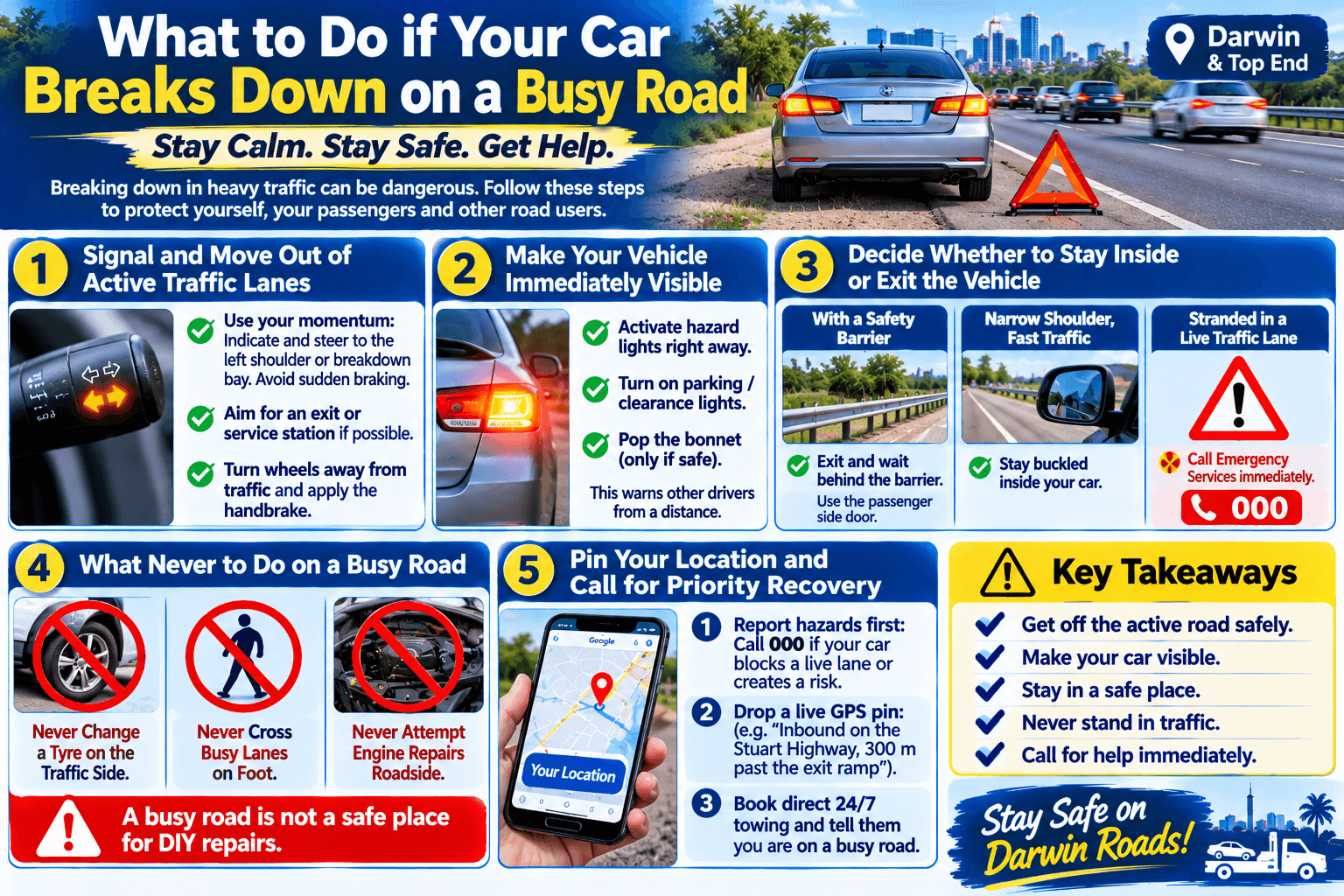
- Signal and Move Out of Active Traffic Lanes
The moment your car begins sputtering, loses acceleration, or displays an urgent red warning light, prioritise getting off the active roadway:
- Use Your Momentum: Indicate immediately and steer smoothly toward the leftmost emergency stopping lane, breakdown bay, or road shoulder. Avoid slamming on the brakes abruptly in live traffic.
- Aim for an Exit or Side Street: If an exit ramp, slip lane, or service station is within safe rolling distance, coast off the main road entirely.
- Turn Your Wheels Away from Traffic: Once stopped, turn your front wheels toward the grass verge or barrier and apply the handbrake firmly. If an inattentive driver strikes your car from behind, this prevents it from rolling back into fast-moving traffic.
- Make Your Vehicle Immediately Visible
Approaching drivers need clear visual cues from a distance to change lanes early:
- Activate Hazard Lights Immediately: Switch on your hazard flashers right away, even in bright daylight.
- Turn On Parking/Clearance Lights: In low light, heavy rain, or overcast conditions, leave your clearance lights on so your vehicle’s width is clearly defined.
- Pop the Bonnet (Only if Safe): Once you are parked well clear of traffic and exiting safely on the non-traffic side, unlatching the bonnet signals to approaching drivers that your vehicle is disabled. Never step near traffic lanes just to open the hood.
- Decide Whether to Stay Inside or Exit the Vehicle
On a busy road, knowing where to wait is critical:
| Road Environment | Safest Action | Key Precaution |
|---|---|---|
| Highway / Arterial with Safety Barrier | Exit and wait behind the barrier | Exit strictly via the passenger-side door (away from traffic) and stand well behind the steel guardrail. |
| Narrow Shoulder, No Barrier, Fast Traffic | Stay buckled inside your car | Keep your seatbelt fastened, lock the doors, and keep hazard lights flashing. |
| Stranded in a Live Traffic Lane | Call Emergency Services (000) immediately | Do not attempt to push the car across busy lanes. Keep seatbelts buckled unless there is smoke or fire. |
- What Never to Do on a Busy Road
- Never Change a Tyre on the Traffic Side: If your right-side tyre blows out on a busy road, do not attempt to jack up the car beside fast-moving traffic. Call a tow truck or roadside patrol equipped with high-visibility beacons.
- Never Cross Busy Lanes on Foot: Never run across multi-lane highways or walk along narrow motorway shoulders looking for help.
- Never Attempt Engine Repairs Roadside: Opening radiator caps or leaning over the engine bay with traffic passing inches away exposes you to both moving vehicles and scalding components.
- Pin Your Location and Call for Priority Recovery
Once you are in a secure position, contact help immediately:
- Report Live-Lane Hazards: If your vehicle is blocking a live traffic lane or creating an immediate traffic hazard, call 000 (or your local traffic management authority) first so traffic response units can shield the scene.
- Drop a Live GPS Pin: Open Google Maps, drop a pin on your exact spot, and note your travel direction (e.g., "Inbound on the Stuart Highway, 300 m past the exit ramp").
- Book Direct 24/7 Towing: If your car cannot be driven safely, call a local tow truck dispatch directly rather than waiting on general mechanical triage, and let them know you are on a busy road so they can prioritise rapid scene clearance.
Need an Honest, Upfront Towing Quote in Darwin?
Our tilt trays are on call 24/7 across Darwin, Palmerston, and surrounding NT highways.