Not every vehicle breakdown requires lights-and-sirens urgency, nor does every flat battery warrant an immediate after-hours call-out. However, certain roadside breakdowns cross the line from a routine mechanical inconvenience into an immediate safety, traffic, or environmental emergency that demands priority dispatch.
Understanding when towing is classified as an emergency helps you make fast decisions on the road—and ensures you request priority clearance when lives, traffic flow, or critical vehicle systems are at risk.
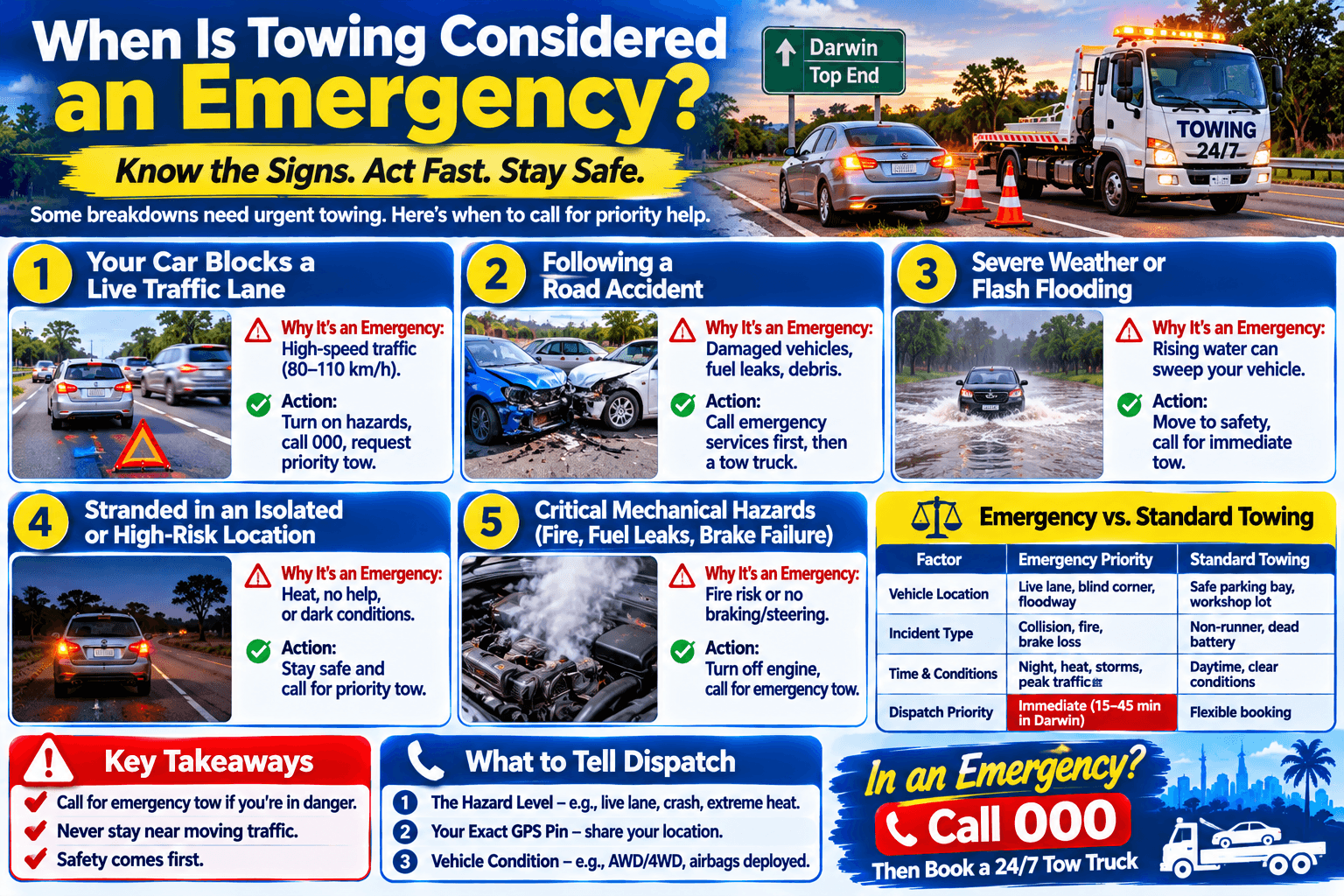
- Your Vehicle Is Blocking a Live Traffic Lane
A stationary vehicle sitting in an active traffic lane, on a blind bend, or at the crest of a hill is an acute collision hazard.
- Why It’s an Emergency: On fast-moving corridors—such as the Stuart Highway, Tiger Brennan Drive, or busy multi-lane intersections—approaching motorists travelling at 80–110 km/h have only seconds to react.
- Immediate Action: Turn on your hazard flashers, call 000 (or your local emergency services) so police or traffic units can shield the lane, and request an emergency priority tow for rapid scene clearance.
- Following a Road Accident or Collision
Any crash involving structural impact, airbag deployment, or immobilized vehicles requires urgent recovery.
- Why It’s an Emergency: Damaged vehicles often leak flammable fuel, slippery engine oil, or toxic coolant onto the roadway, while sharp metal debris and shattered glass endanger other road users.
- Immediate Action: Check for injuries and call emergency services first if anyone is hurt or if hazards block the road. Once police clear the scene for recovery, an emergency flatbed tilt-tray removes the damaged vehicle safely to a repairer or holding yard.
- Severe Weather or Flash Flooding Stranding
In tropical regions like Darwin and the Top End, sudden wet-season monsoonal downpours can rapidly flood low-lying causeways, intersections, and rural roads.
- Why It’s an Emergency: Rising water levels can sweep a stalled vehicle off the roadway, stall rescue access, or submerge electrical systems.
- Immediate Action: Never attempt to restart a vehicle that has stalled in water, and never stay inside a car surrounded by rising floodwaters. Move to safe higher ground and call emergency services and a 24/7 recovery operator immediately.
- Stranded in an Isolated or High-Risk Location
Where your vehicle breaks down—and the time of day—often determines whether the situation is an emergency:
- Extreme Heat Exposure: In Darwin’s 35°C+ build-up and dry-season heat, breaking down with no air conditioning or shade poses a serious risk of heatstroke, particularly for elderly passengers, children, or pets.
- Unlit Nighttime Shoulders: Being stranded after dark on an unlit rural highway with narrow verges significantly increases the risk of secondary rear-end collisions and personal security concerns.
- Remote Out-of-Range Areas: Breaking down kilometres from town with limited mobile signal or water requires urgent, coordinated recovery.
- Critical Mechanical Hazards (Fire, Fuel Leaks, or Brake Failure)
Some mechanical faults make attempting to drive—or even waiting near the vehicle—dangerous:
- Smoke, Sparks, or Burning Smells: Indicates an electrical short circuit or ruptured fuel line hitting hot exhaust components, risking a vehicle fire.
- Total Brake or Steering Failure: A vehicle that cannot stop or steer safely cannot be driven even a few hundred metres to the nearest workshop.
- Overheated Engine With Boiling Coolant: Steam erupting from under the bonnet poses severe scald risks and requires immediate shutdown and flatbed recovery.
Emergency vs. Standard Towing: Quick Comparison
| Factor | Emergency Priority Towing | Standard / Scheduled Towing |
|---|---|---|
| Vehicle Location | Live traffic lane, blind corner, highway shoulder, or floodway | Home driveway, safe parking bay, or workshop lot |
| Incident Type | Collision, fire/fuel hazard, total brake loss, or severe weather stranding | Non-runner project car, scheduled workshop transfer, or dead battery in a safe bay |
| Time & Conditions | Late night, extreme heat, storms, or peak-hour traffic bottlenecks | Daytime hours in safe, clear conditions |
| Dispatch Priority | Immediate 24/7 rapid response (typically 15–45 mins in metro Darwin) | Flexible booking window arranged around your schedule |
What to Tell Dispatch During an Emergency Tow Call
To ensure your call is flagged for immediate priority dispatch, clearly state:
- The Hazard Level: Mention right away if you are blocking a live lane, involved in a crash, or stranded with children/elderly passengers in extreme heat or at night.
- Your Exact GPS Pin: Share your live Google Maps coordinates and travel direction.
- Vehicle Condition & Drivetrain: Specify if wheels are locked, airbags deployed, or if the car is AWD/4WD so the driver brings the right tilt-tray and recovery skates on the first trip.
Need an Honest, Upfront Towing Quote in Darwin?
Our tilt trays are on call 24/7 across Darwin, Palmerston, and surrounding NT highways.